Olha Sharafanenko has been painting for as long as she can remember. She began her first art classes in Odesa at just three years old, and from that point on, creating became her way of understanding herself and connecting with the world.
“We moved a lot across Ukraine, and each new city left me with myself—with my solitude. That was especially difficult during my teenage years. But painting was always there—it was the key to who I was.”

The Academy as a School of Strength
From the beginning, Olha knew she wanted to study at the National Academy of Fine Arts and Architecture in Kyiv, a leading institution for academic painting in Ukraine. Over time, it became a place where she learned both artistic skills and life lessons.
“There were times when I thought about leaving. The creative environment was still shaped by a post-Soviet mindset, and the teaching methods could be strict and, at times, ethically questionable.” Still, the experience became a kind of character training for her. “I often had to put in triple the effort just to meet the so-called academic standards. At the Academy, technical execution was consistently valued above creative concept.”
That experience gave her a powerful foundation—knowledge of painting, drawing, restoration, and art history. “Today, I’m grateful I went through it,” she reflects. “Now I have a strong arsenal to create my own work and to teach others.”

From Kyiv to Berlin
Moving to Berlin was a turning point for her. After the structured environment of academic training, she was introduced to the open, exploratory world of conceptual art. “Berlin taught me to be versatile, to work across disciplines, and to see life itself as a form of art.”
One of the most transformative periods in her journey was a residency at BAi (Berlin Art Institute) during the full-scale war in Ukraine. Surrounded by an international community of artists, she was introduced to new, more exploratory ways of creating.
“What struck me most was learning to value every part of the process—whether it was research, a conversation, or even an inspiring walk. In Kyiv, the focus was always on the final result: if you didn’t finish a canvas, the day felt wasted. That kind of pressure was intense. Berlin taught me that the process itself holds just as much meaning as the final work.”
Shaping the Process
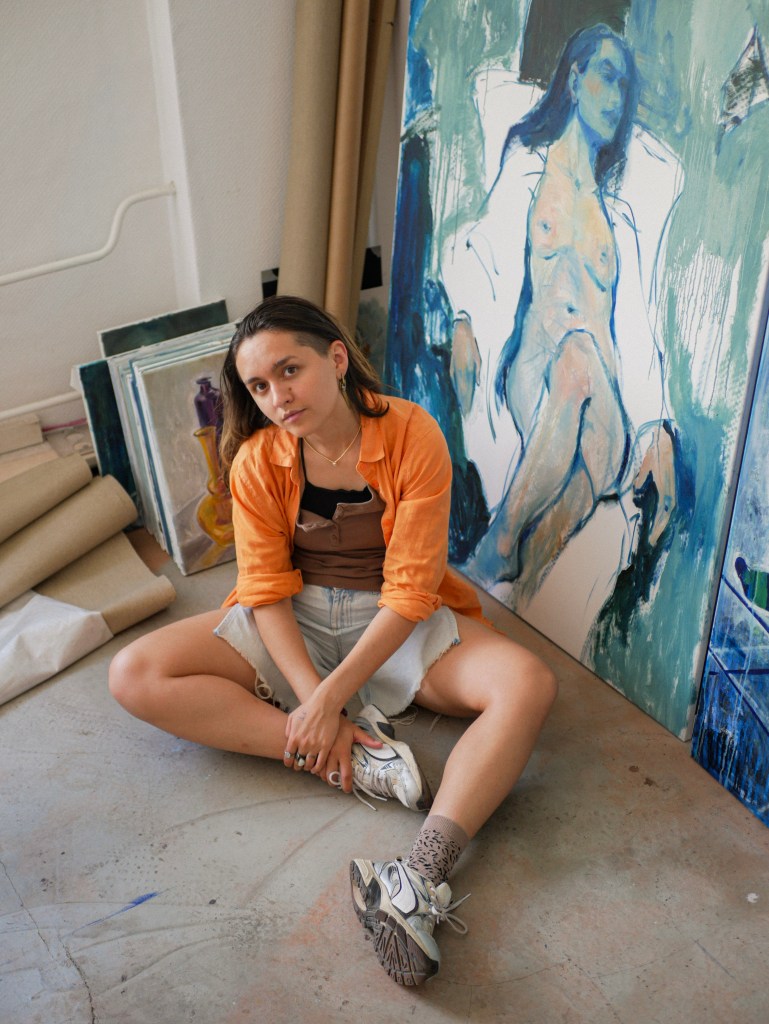
Olha’s creative process often begins with a feeling—an emotion she gradually shapes into form, language, and narrative. Her paintings serve as reflections of personal experience and her engagement with the world around her.
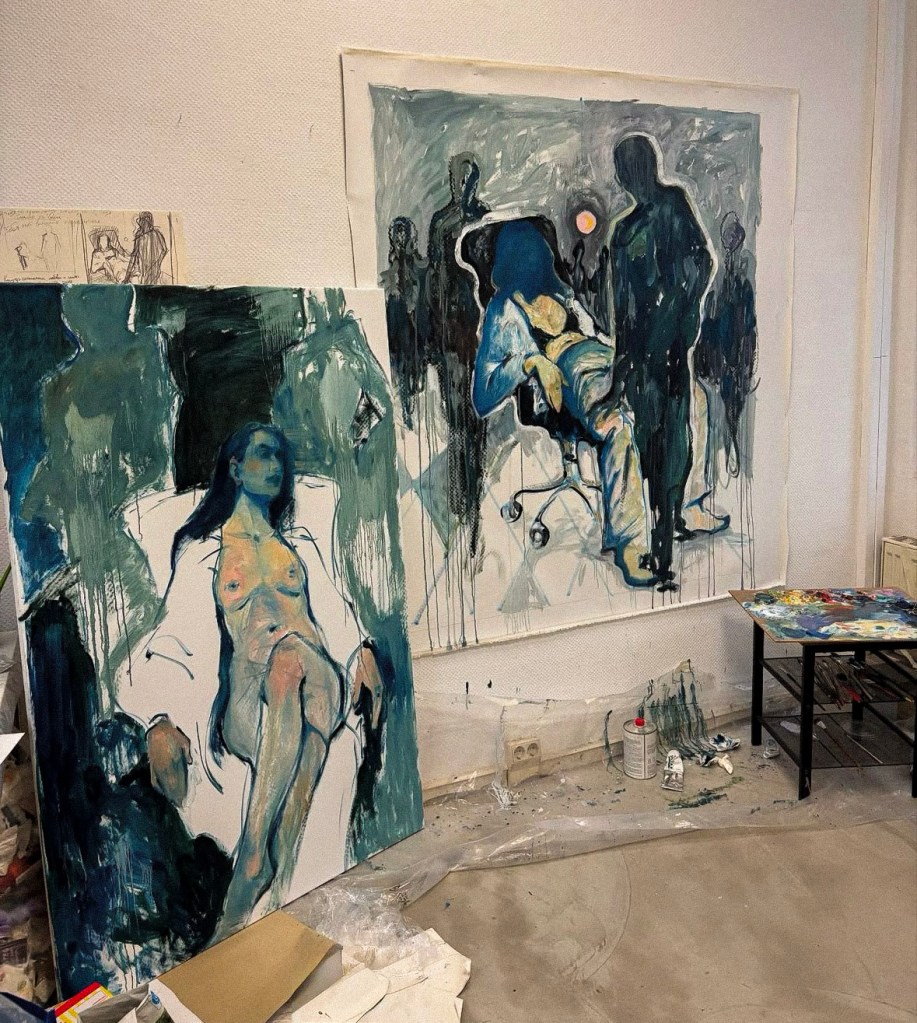
Color holds significant weight in her work. “For me, blue represents transcendence. It allows me to remain in a state of transition without falling into the duality of ‘good’ or ‘bad.’ To me, experience itself is blue.”
The human body and the observation of people remain constant sources of inspiration. “I’ve always been intrigued by the mystery of human feeling, interaction, and how emotions can take physical shape.”
Her way of speaking often reflects a thoughtful, philosophical side, which is no accident. One of her favorite writers, Hermann Hesse, once wrote: “We can understand one another, but each of us can only explain himself.”
Olha’s Influences
Philosophy and spirituality have been integral to Olha’s artistic journey. For some time, she viewed the world through the lens of Hinduism, with the Bhagavad Gita becoming a lasting source of guidance. More recently, her focus has turned to Kabbalah, Western occultism, and existentialist philosophy.
Some of the books that have shaped her perspective include “In the Flow” by Boris Groys and “No Exit” by Jean-Paul Sartre. Among the artists she draws inspiration from are Lucian Freud, Giorgio Morandi, Vova Keno, Mikhail Guida, Ruprecht von Kaufmann, and others.
The Future: Play and Collaboration
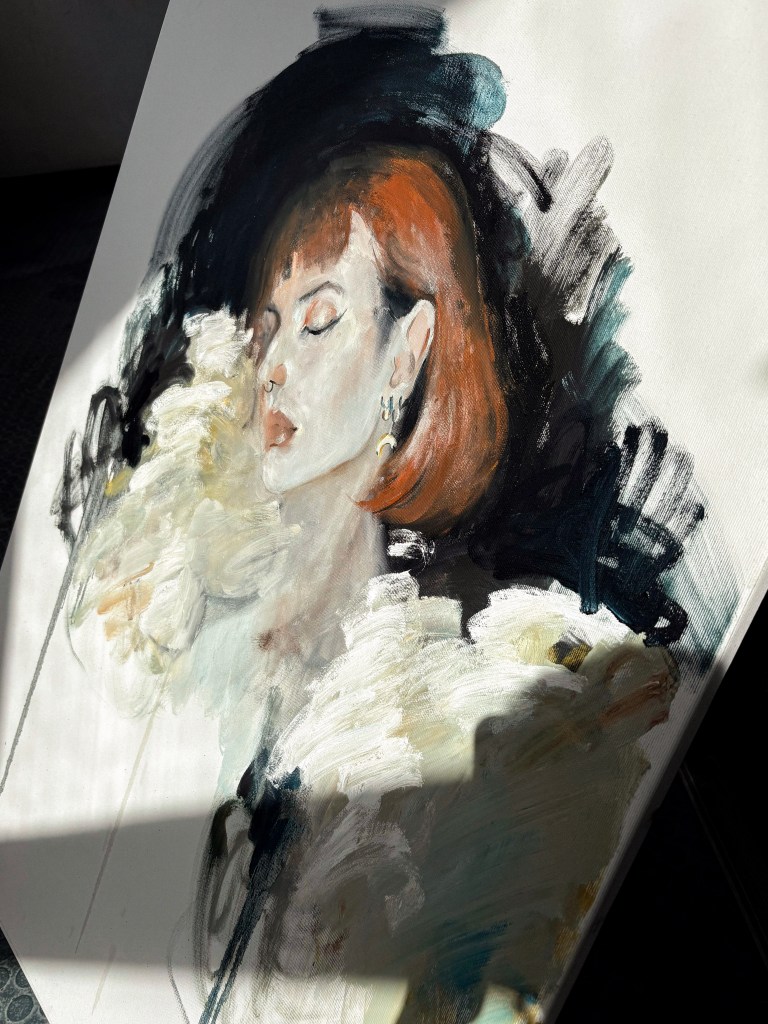
Olha gives space for her inner child to imagine, explore, and play. “I’m always drawn to experimentation—with new materials, forms, and collaborative work. I’d love to explore installation, create projects in public spaces like murals, and even try glassblowing. I’m motivated by challenges and by engaging with people. What excites me most is creating more opportunities for dialogue—about the things that truly matter.”
For Olha, art is not just a finished piece but a journey—where experience, philosophy, observation, and play all come together.
Discover more about Olha’s artistic journey on her website
